What Is a Full-Grain Leather Handbag and Why Is It the Only Grade Worth Buying?
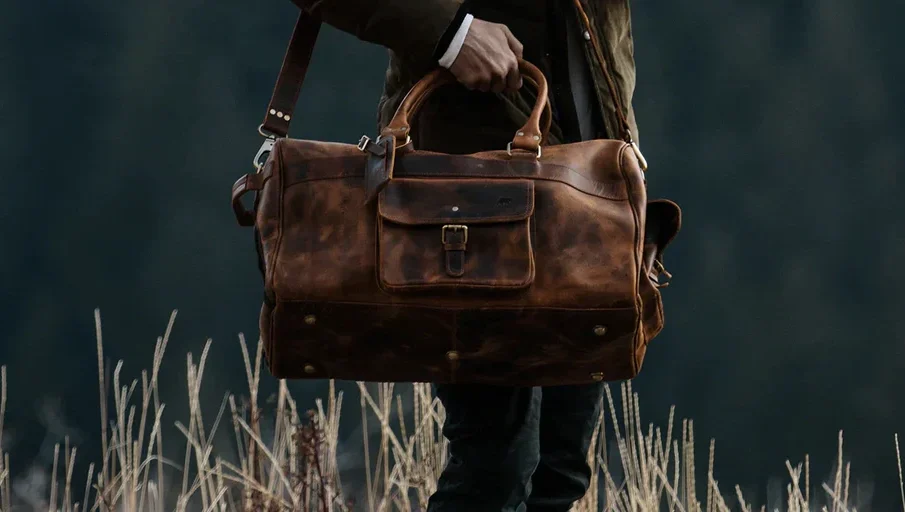
A full-grain leather handbag is a bag made from the outermost, most densely fibred layer of the hide with the complete natural grain surface intact and unaltered – the highest grade of leather in the material hierarchy – featuring a surface that is more resistant to wear, moisture, and mechanical stress than any lower grade, that develops a rich personal patina through use that no other leather grade replicates, and that delivers a 15-20 year functional lifespan that makes the initial investment the most economically efficient choice across any realistic ownership horizon. Full-grain leather is not the most expensive option in a handbag – it is the only option that earns its cost.
Rustic Town’s full-grain leather handbag collection for women – vegetable-tanned, handcrafted in Rajasthan, from under $100.
What Is the Leather Grade Hierarchy and Where Does Full-Grain Sit?
| Grade | What It Is | Surface Integrity | Patina | Lifespan | Typical Use |
| Full-grain | Top layer of hide – natural grain completely intact | Complete – densest, strongest | Excellent – deepens with use | 15-20+ years | Premium bags, saddles, quality goods |
| Top-grain | Top layer – surface sanded to remove blemishes | Modified – uniform but weaker | Moderate | 8-12 years | Mid-range bags, belts |
| Corrected-grain | Top layer – heavily treated, embossed grain | Artificial – uniform pattern | Minimal | 5-8 years | Mass market bags |
| Split leather | Lower hide layers – no grain surface | None – relies on coating | None | 3-5 years | Low-cost goods |
| Genuine leather | Lowest grade – marketing term | Coating only – not natural leather | None | 2-3 years | Budget accessories |
| Bonded leather | Shredded leather scraps on backing | None – artificial surface | None | 1-3 years | Cheap upholstery, fast fashion |
The leather industry’s most confusing consumer deception is the word genuine. Genuine leather is not a quality descriptor – it is the lowest grade of real leather in commercial use. A bag described as genuine leather will begin peeling or cracking within two to three years of regular use. A bag described specifically as full-grain leather will still be in daily use in 15 years. Understanding this one vocabulary distinction changes every handbag purchase decision a woman makes for the rest of her life.
Why Does Full-Grain Leather Develop Patina and Other Grades Do Not?
The grain surface is the natural protective and responsive layer of the hide.
The outermost grain layer of a hide contains the densest concentration of natural leather fibres, natural oils, and the biological surface structure that responds to use, handling, and environmental exposure by deepening in tone and character. This surface is present and intact on full-grain leather. It is removed or compromised on every lower grade through sanding, buffing, or chemical treatment processes that make the surface uniform but destroy its responsiveness.
Natural oils redistribute with contact.
The natural oils in full-grain leather migrate to the surface under hand contact and body heat during carrying – concentrating in the most-handled areas of the bag and creating the tonal variation that constitutes patina. This oil migration is a property of the intact grain layer and does not occur in treated, coated, or processed leather surfaces that have been sealed with artificial finishes.
The surface accepts conditioning products into the grain.
A beeswax or lanolin leather conditioner applied to full-grain leather is absorbed into the grain structure and reinforces the natural oils that drive patina development. The same conditioner applied to a coated or treated leather surface sits on top of the coating without penetration and is wiped away with minimal effect. Full-grain leather maintenance works. Lower grade leather maintenance is largely cosmetic.
What Is Vegetable Tanning and Why Does It Produce the Best Full-Grain Leather?
The tanning process determines how leather responds over time.
Tanning is the process that converts raw hide into usable leather by stabilising the collagen fibre structure. The two primary industrial tanning methods – vegetable tanning and chrome tanning – produce leather with distinctly different long-term properties.
Vegetable tanning uses plant-based tannins.
Oak bark, chestnut, and other plant-derived tannins are used in the traditional vegetable tanning process. The process takes weeks rather than days, produces a firmer, denser leather that softens and develops character through use, and results in leather that accepts natural finishing treatments and ages with the richest patina of any tanning method. Rustic Town’s Rajasthan artisans use vegetable tanning.
Chrome tanning is faster but produces a different end product.
Chrome-tanned leather is softer from the start, more uniform, and more resistant to water in the short term. It does not develop the same depth of patina as vegetable-tanned leather over time and is the tanning method used for the vast majority of commercial bag production. For a buyer who wants the leather to look the same in year 10 as year 1, chrome tanning is appropriate. For a buyer who wants the leather to become more distinctive over time, vegetable tanning is the correct choice.
How Do You Identify Full-Grain Leather When Shopping?
| Indicator | What It Tells You | Red Flag |
| Product description says ‘full-grain’ | Explicitly stated – the strongest indicator | Any description using only ‘genuine’ or ‘premium’ |
| Visible natural grain variation | Natural grain is never perfectly uniform | Perfectly uniform, repeating grain pattern |
| Leather smell | Natural, warm, earthy smell of tanned hide | Plastic or chemical smell on new bag |
| Edge finish | Natural cut edges burnished or painted | Perfectly uniform machine-cut edges only |
| Price point | Under $100 is possible for artisan brands | Free shipping + under $30 = not full-grain |
| Surface texture under light | Subtle natural variation visible | Perfectly smooth, mirror-like surface = coated |
Browse Rustic Town’s range of full grain leather purse women options – natural grain, vegetable tanned, handcrafted.
Frequently Asked Questions: Full-Grain Leather Handbags
Q: What is full-grain leather?
A: The highest grade of leather – the outermost layer of the hide with the natural grain surface completely intact and unmodified. The densest, most durable, and most patina-developing leather available for bag construction.
Q: How is full-grain leather different from genuine leather?
A: Completely different grades. Full-grain is the highest grade with the natural grain intact – lasts 15-20 years and develops patina. Genuine leather is the lowest commercial grade with only a surface coating – lasts 2-3 years and degrades rather than develops character.
Q: Does full-grain leather scratch easily?
A: Full-grain leather can show minor surface scratches. Most shallow scratches in full-grain leather buff out with a fingertip or a soft cloth as the natural oils redistribute across the grain surface. Deep scratches are more persistent but often add to the patina character rather than detracting from it.
Q: How do I know if a bag is full-grain leather?
A: Look for ‘full-grain’ stated explicitly in the product description. Natural grain variation visible on the surface, a warm earthy smell, and burnished or painted natural cut edges are all indicators. Perfect uniformity of surface grain is a red flag for a processed or artificial surface.
Q: Is full-grain leather water resistant?
A: Full-grain leather has natural water resistance from its grain oils. It is not waterproof – sustained exposure to water without treatment will mark the surface. Blot water exposure immediately and apply conditioner after drying to maintain the grain’s natural resistance.
Q: What is the price of a Rustic Town full-grain leather handbag?
A: Rustic Town full-grain leather bags for women are priced under $100 – the price point where artisan construction and full-grain leather material quality are delivered without the brand premium of established fashion houses.
Q: How long does a full-grain leather handbag last?
A: 15-20 years with basic maintenance – monthly wiping and 6-monthly leather conditioning. Some full-grain leather bags from quality artisan brands last well beyond 20 years.
Explore Rustic Town’s vegetable tanned leather bag for women – the gold standard in leather quality, from under $100.